

Why Salespeople Should Be the Loudest Advocates for AI
The study that should change how every sales leader thinks about automation.
A new report by Anthropic, one of the world’s leading artificial intelligence companies, has mapped exactly how vulnerable different professions are to AI-driven automation. The findings are striking — and for sales managers and revenue leaders, they raise an urgent question that goes beyond fear: are your teams using AI enough?
The Numbers Behind the Headline
The report introduces a concept called “observed exposure” — a measure that combines what AI is theoretically capable of doing with what is actually being used in real workplaces today.
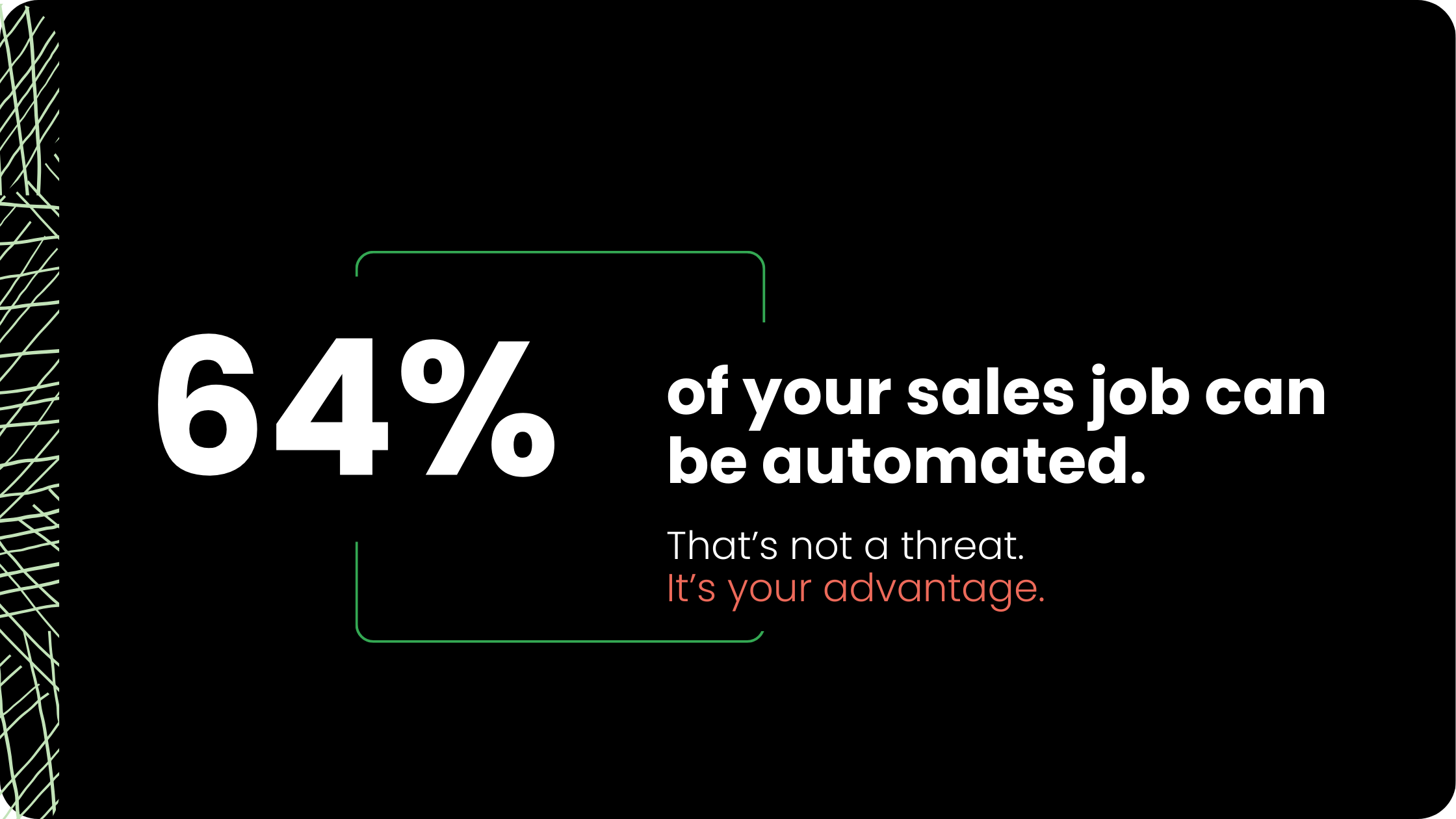
For sales and marketing roles, the gap is significant. Artificial intelligence can theoretically handle around 64% of day-to-day sales tasks — prospecting research, CRM data entry, outreach email generation, pipeline reporting, and proposal drafting. Yet real-world AI adoption in sales currently covers only about 33% of that capability.
That gap is not a technology problem. It is an adoption problem. And it represents a significant untapped opportunity for sales teams willing to push for change.
Will AI Replace Salespeople? Here’s What the Data Actually Says
The question of whether AI will replace salespeople is one of the most searched topics in the future of work conversation. The Anthropic study offers a nuanced answer — and it is more reassuring than most headlines suggest.
The core of sales — building trust over time, reading a room, negotiating live, knowing when to push and when to pull back — remains firmly beyond what current AI systems can replicate. These are not automatable skills. They are deeply human, contextual, and relationship-driven.
The 36% of sales work that AI cannot do is precisely the part that drives revenue. Closing deals. Managing key accounts. Navigating complex buying committees. Earning referrals through years of genuine relationship building.
Sales professionals are not replaceable. Not where it counts.
However — and this is the critical point for sales leaders — that irreplaceability only holds up when salespeople are actually spending their time on high-value activities. If 64% of a sales rep’s day is consumed by tasks that intelligent automation could handle, they are not selling. They are administering.
The Hidden Threat: It’s Not Layoffs, It’s Hiring
The Anthropic study also surfaces a subtler but equally important finding for sales managers thinking about team structure and future of sales jobs.
Mass layoffs driven by AI automation have not materialized — at least not yet. What has happened is quieter and arguably more significant: hiring has slowed. The study found a 14% drop in the job-finding rate for workers in AI-exposed roles. Companies are not firing their sales teams. They are simply not replacing them when they leave.
The consolidation is already underway. Fewer sales reps are being hired to generate the same revenue. And the ones getting hired are increasingly being evaluated not just on their ability to close, but on their proficiency with AI tools, sales automation platforms, and data-driven workflows.
The job description for a modern sales professional has already changed. The question is whether your team has noticed.
The Case for Sales Leaders to Drive AI Adoption
This is where the conversation shifts from threat to opportunity — and where forward-thinking sales managers can create a genuine competitive advantage.
Advocating for AI adoption in sales is not about replacing people. It is about redirecting their time. If intelligent automation can absorb the administrative and operational burden of the 64%, sales professionals are freed to focus entirely on the 36% that no machine can replicate.
More time on discovery calls. More time building relationships. More time closing. More commission.
The organizations that move fastest on sales process automation will not just be more efficient — they will be more human where it matters most.
The sales teams that resist automation, on the other hand, face a different future. Not sudden displacement, but gradual irrelevance. Slower hiring. Shrinking headcount. A widening gap between what they produce and what AI-enabled competitors produce.
What Sales Leaders Should Do Now
The Anthropic study makes one thing clear: the future of sales jobs belongs to professionals and organizations that treat AI as a tool to be demanded, not a threat to be feared.
Sales managers and revenue leaders should be asking their organizations the following:
What percentage of our sales workflow is still manual that does not need to be? Which repetitive tasks are consuming our reps’ selling time? What AI tools for sales teams are available that we have not yet implemented? How are we evaluating AI proficiency in our hiring and performance frameworks?
The gap between AI’s theoretical capability and its real-world adoption in sales is not inevitable. It is a choice. And right now, it is a choice that is costing sales teams time, pipeline, and revenue every single day.
The Bottom Line
AI will not replace great salespeople. But it will replace the parts of their job that were never worthy of their talent in the first place.
The smartest sales leaders are not waiting for their organization to hand them an AI strategy. They are building the case, making the ask, and driving adoption from the inside.
Because in sales, efficiency is not just an operational metric.
It is money.
This article was written by Luna Ghannam founder of Autowalk, a B2B marketing and sales automation company that builds prebuilt automated systems for SMEs.